Uses :
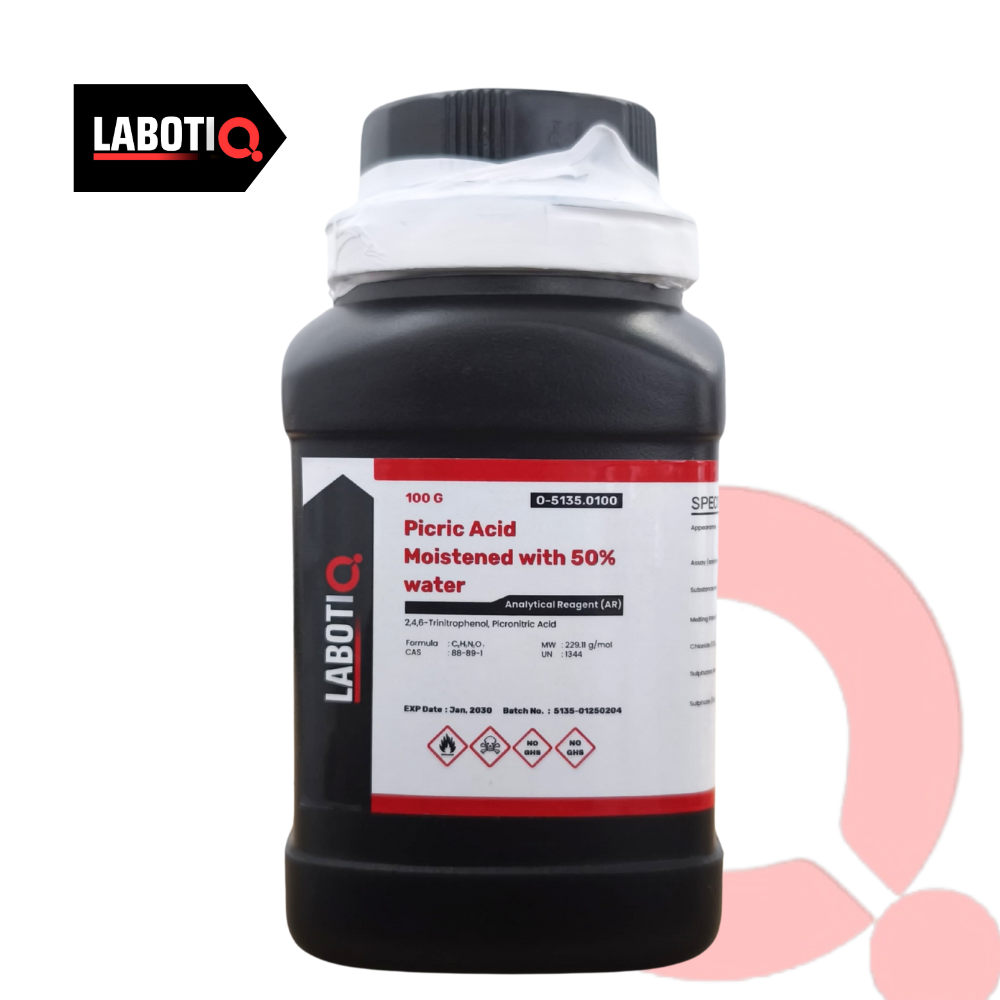
By far the greatest use of picric acid has been in ammunitions and explosives. Explosive D, also known as Dunnite, is the ammonium salt of picric acid. Dunnite is more powerful but less stable than the more common explosive TNT (which is produced in a similar process to picric acid but with toluene as the feedstock). Picramide, formed by aminating picric acid (typically beginning with Dunnite), can be further aminated to produce the very stable explosive TATB.
It has found some use in organic chemistry for the preparation of crystalline salts of organic bases (picrates) for the purpose of identification and characterization.
In metallurgy, a 4% picric acid in ethanol etch, termed “picral”, has been commonly used in optical metallography to reveal prior austenite grain boundaries in ferritic steels. The hazards associated with picric acid have meant it has largely been replaced with other chemical etchants. However, it is still used to etch magnesium alloys, such as AZ31.
Histology
Bouin solution is a common picric-acid–containing fixative solution used for histology specimens. It improves the staining of acid dyes, but it can also result in hydrolysis of any DNA in the sample.
Picric acid is used in the preparation of Picrosirius red, a histological stain for collagen.
Blood tests
Clinical chemistry laboratory testing utilizes picric acid for the Jaffe reaction to test for creatinine. It forms a colored complex that can be measured using spectroscopy.
Picric acid forms red isopurpurate with hydrogen cyanide (HCN). By photometric measurement of the resulting dye, picric acid can be used to quantify hydrogen cyanide.
During the early 20th century, picric acid was used to measure blood glucose levels. When glucose, picric acid and sodium carbonate are combined and heated, a characteristic red color forms. With a calibrating glucose solution, the red color can be used to measure the glucose levels added. This is known as the Lewis and Benedict method of measuring glucose.
Skin dye
Much less commonly, wet picric acid has been used as a skin dye, or temporary branding agent. It reacts with proteins in the skin to give a dark brown color that may last as long as a month.
Antiseptic
During the early 20th century, picric acid was stocked in pharmacies as an antiseptic and as a treatment for burns, malaria, herpes, and smallpox. Picric-acid–soaked gauze was commonly stocked in first aid kits from that period as a burn treatment. It was notably used for the treatment of burns suffered by victims of the Hindenburg disaster in 1937. Picric acid was used as a treatment for trench foot suffered by soldiers stationed on the Western Front during World War I.
Picric acid has been used for many years by fly tyers to dye mole skins and feathers a dark olive green for use as fishing lures. Its popularity has been tempered by its toxic nature.