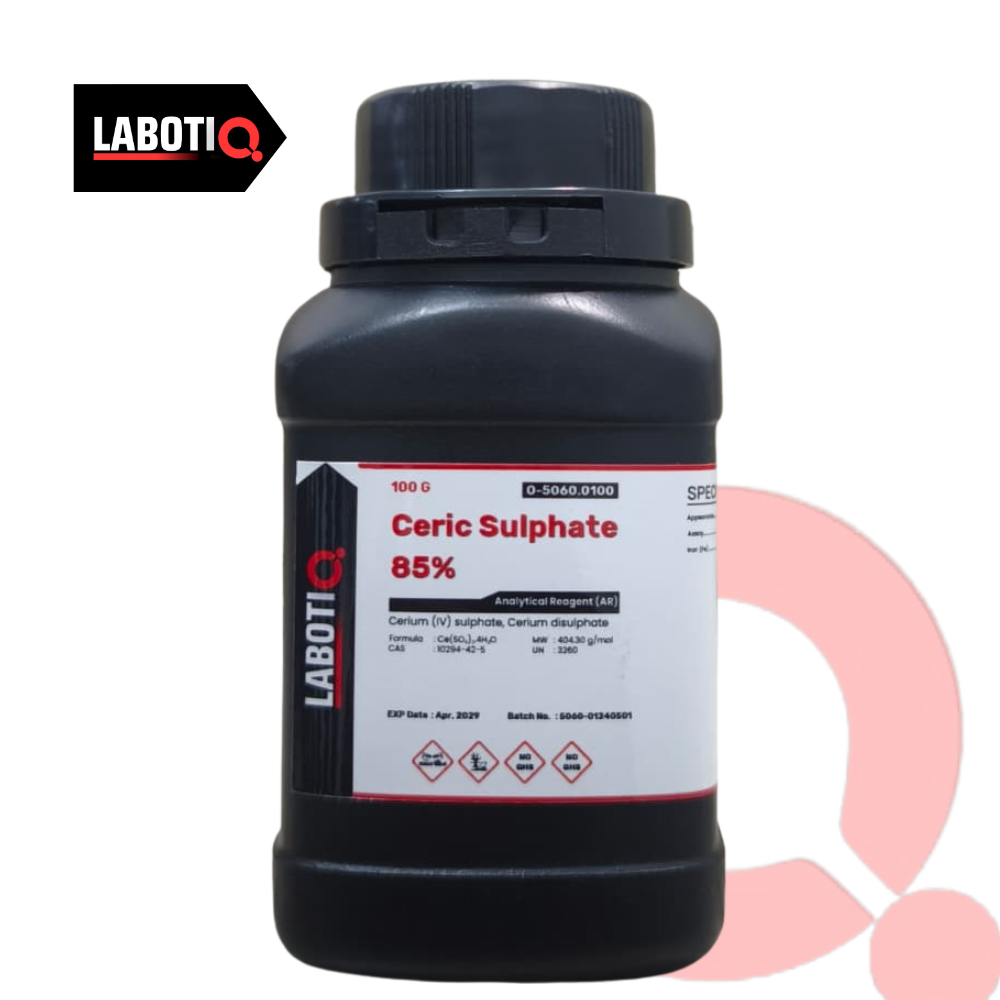
Cerium(IV) sulfate, also called ceric sulfate, is an inorganic compound. It exists as the anhydrous salt Ce(SO4)2 as well as a few hydrated forms: Ce(SO4)2(H2O)x, with x equal to 4, 8, or 12. These salts are yellow to yellow/orange solids that are moderately soluble in water and dilute acids. Its neutral solutions slowly decompose, depositing the light yellow oxide CeO2. Solutions of ceric sulfate have a strong yellow color. The tetrahydrate loses water when heated to 180-200 °C.It is insoluble in glacial acetic acid and pure (96%) ethanol.It was historically produced by direct reaction of fine, calcined cerium (IV) oxide and concentrated sulfuric acid, yielding the tetrahydrate.
Ceric Sulphate 85% AR is a yellow, crystalline, solid form of cerium(IV) sulfate with a minimum purity of 85%, designated as “AR” for Analytical Reagent grade, indicating high quality for laboratory use, particularly as a strong oxidizing agent in redox titrations.